A missing tooth can affect more than your smile. Depending on where the tooth is missing, it can make chewing less comfortable, affect speech, allow neighbouring teeth to shift, and make a removable denture or bridge necessary.
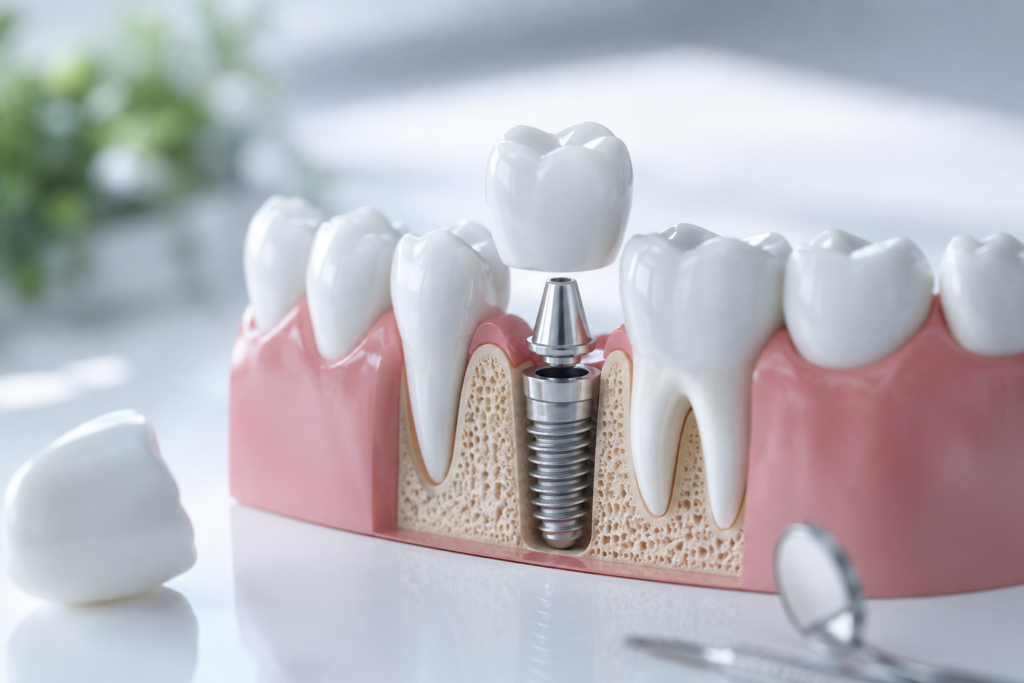
Dental implants offer one established way to replace a missing tooth by placing an artificial tooth root into the jawbone and attaching a restoration such as a crown. Unlike a conventional bridge, an implant replaces the root as well as the visible tooth.
But an implant is not simply a “tooth replacement” procedure. It is a planned surgical and restorative treatment, and the right approach depends on your bone, gums, remaining teeth, medical history, bite and the type of tooth being replaced.
This guide explains how dental implants work, what the procedure involves, how much treatment can cost in India, how long recovery takes, how implants compare with bridges, how long they can last, and which common implant myths deserve a second look.
What Are Dental Implants?
A dental implant is a small artificial tooth root, usually made from titanium, that is surgically placed into the jawbone.
Once the implant integrates with the surrounding bone, it can support a:
- Single dental crown
- Fixed bridge
- Implant-supported denture
- Full-arch restoration
The visible replacement tooth is not the implant itself. A typical implant restoration consists of three main components:
| Component | Purpose |
|---|---|
| Implant | Artificial tooth root placed in the jawbone |
| Abutment | Connector between implant and restoration |
| Crown/bridge/denture | Visible replacement supported by the implant |
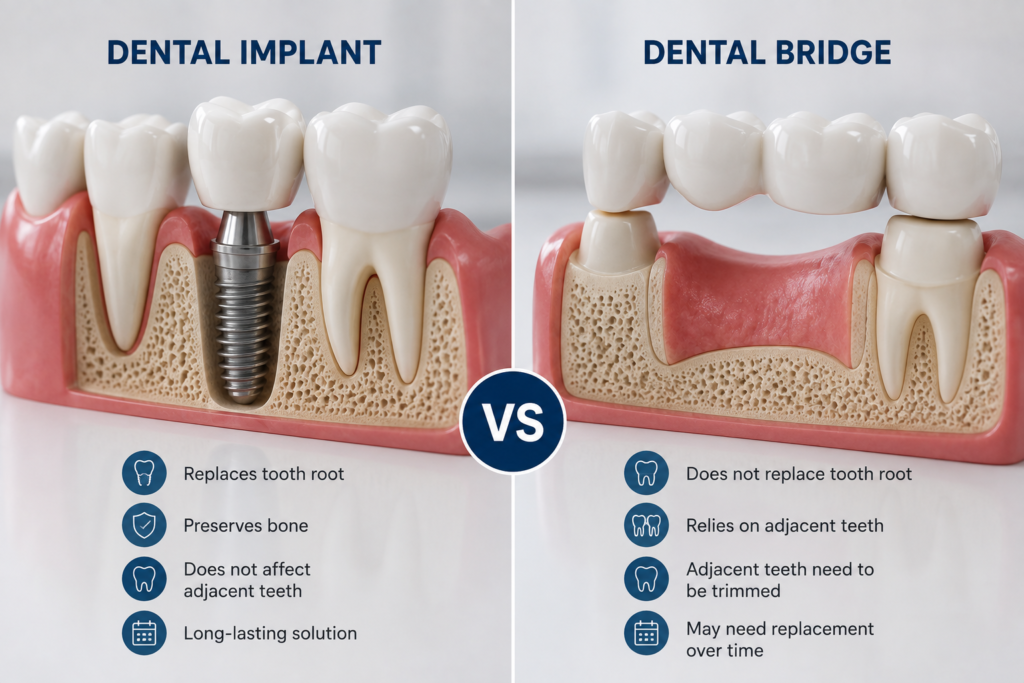
The implant therefore functions differently from a traditional bridge, which uses neighbouring teeth for support.
Who Can Benefit From Dental Implants?
Dental implants may be considered for people who have:
- One missing tooth
- Several missing teeth
- Teeth that cannot be predictably restored
- Difficulty using conventional dentures
- A need for an implant-supported bridge
- Complete tooth loss requiring an implant-supported full-arch solution
However, having a missing tooth does not automatically mean an implant is the best treatment.
Your dentist needs to assess the available bone, gum health, neighbouring teeth, bite and overall medical history before recommending treatment.
Untreated periodontal disease, poor oral hygiene, smoking and some medical conditions can increase the risk of complications. The FDA specifically notes that local infection, untreated periodontal disease, difficulty maintaining hygiene and delayed healing associated with smoking can affect implant outcomes.
Dental Implant Procedure: Step by Step
Although treatment differs from patient to patient, dental implant treatment generally involves several stages.
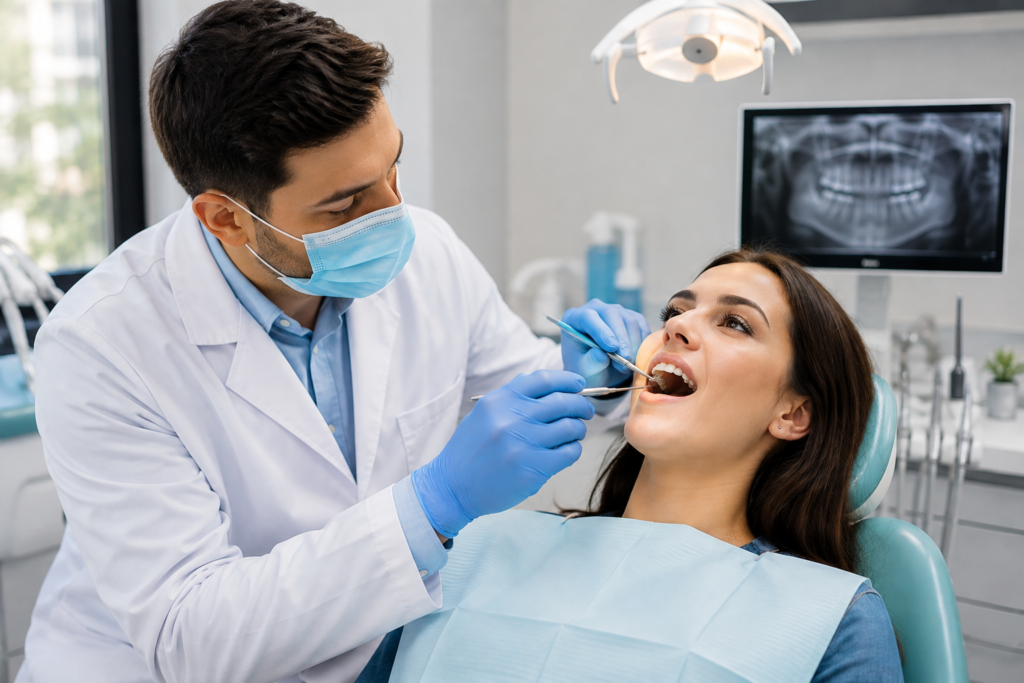
Step 1: Dental examination and treatment planning
The process starts with an examination rather than surgery.
Your dentist will assess:
- The missing tooth or teeth
- Remaining teeth
- Gum condition
- Jawbone volume
- Bite and spacing
- Previous dental treatment
- Medical history
- Oral hygiene
- Smoking status
- Any medications or conditions that could affect healing
Dental X-rays and, where indicated, 3D imaging can help the dentist evaluate the proposed implant site and plan treatment.
The NHS describes pre-operative assessment, imaging and impressions as part of the planning process.
Step 2: Treat existing dental problems
An implant should not be viewed in isolation from the rest of your mouth.
If you have active gum disease, infection, severely damaged neighbouring teeth or other oral-health problems, these may need to be addressed before implant placement.
This is one reason a proper treatment plan is more important than simply asking for the cheapest dental implant available.
Step 3: Bone assessment and possible bone grafting
Dental implants require adequate bone for support.
If the jawbone has lost significant volume after tooth loss, trauma or other causes, your dentist may recommend a bone-grafting or bone-regeneration procedure.
Not everyone needs a bone graft.
If grafting is required, it can add several months to the overall treatment timeline. One NHS implant service notes that bone grafting can extend treatment by around four to six months in some cases.
Step 4: Implant placement
During implant surgery, the area is normally numbed with local anaesthetic.
The dentist or oral surgeon accesses the jawbone, prepares the implant site and places the implant into the bone before closing the gum around it, depending on the surgical approach.
A single implant placement can be relatively short, but the exact duration depends on the location, number of implants, surgical complexity and whether additional procedures are required.
Step 5: Osseointegration — the healing phase
After placement, the implant needs time to integrate with the surrounding bone.
This process is called osseointegration.
The implant is not simply “screwed in and finished.” Biological healing is a crucial part of treatment.
Depending on the case and treatment protocol, the implant may need several months before it is ready to support the final restoration. NHS guidance notes that implants often require at least three months before supporting replacement teeth, while another NHS implant service describes integration periods of approximately two to six months in many cases.
Step 6: Abutment and restoration
Once the implant is sufficiently integrated, the restorative phase begins.
The dentist takes the necessary measurements or digital scans and plans the replacement tooth.
Depending on the case, this could be:
- A crown for one missing tooth
- An implant-supported bridge for several missing teeth
- An implant-supported denture
- A full-arch fixed restoration
The final restoration is designed to function with your bite and fit the surrounding teeth.
Step 7: Follow-up and maintenance
Treatment does not end when the crown is fitted.
Implants require ongoing professional monitoring and daily home care.
Regular dental examinations can help identify problems involving the gums, bone, implant components or restoration before they become more difficult to manage. NHS guidance also emphasizes regular follow-up care for dental implants.
Dental Implant Recovery Timeline
Recovery has two different meanings in implant dentistry:
- Initial surgical recovery — when swelling, soreness and soft-tissue healing settle.
- Implant integration — when the implant becomes biologically integrated with the jawbone.
These are not the same thing.
First 24–48 hours
Some soreness, swelling, bruising or minor bleeding can occur after implant surgery.
Pain is generally managed with medication recommended by the dental team.
Following your dentist’s instructions regarding food, oral hygiene, medication and activity is more important than trying to follow a generic recovery schedule.
First week
The gum begins to heal, and any sutures are assessed or removed according to the surgical technique.
An NHS patient guide recommends a follow-up appointment approximately 7–14 days after treatment to assess healing and remove stitches where necessary.
First few weeks
The soft tissues continue healing, but the implant may still be undergoing deeper biological integration.
You should not assume that because the gum feels normal, the implant is already ready for unrestricted function.
Two to six months
This is a common range discussed for implant integration, although actual timing varies considerably.
Some cases can follow shorter treatment protocols, while others require longer healing because of bone grafting, implant position, bone quality or other clinical factors.
Final restoration
Once the dentist determines that the implant is ready, the crown, bridge or other restoration can be completed.
The entire treatment may therefore take considerably longer than the surgical appointment itself.
How Much Do Dental Implants Cost in India?
There is no single “dental implant cost” that applies to every patient.
A quotation can vary according to:
- Number of missing teeth
- Implant system and components
- Type of crown or restoration
- Bone grafting requirements
- Extraction requirements
- Diagnostic imaging
- Surgical complexity
- Temporary restorations
- Laboratory charges
- Whether one tooth, several teeth or a full arch is being treated
- Experience and expertise of the treating dental team
This is why comparing clinics solely by an advertised implant price can be misleading.
Ask whether the quoted price includes the complete treatment
Before accepting an implant quotation, ask whether it includes:
| Cost component | Ask whether included |
|---|---|
| Consultation | Yes / No |
| X-rays or 3D imaging | Yes / No |
| Implant fixture | Yes / No |
| Abutment | Yes / No |
| Crown | Yes / No |
| Extraction | Yes / No |
| Bone graft | Yes / No |
| Temporary tooth | Yes / No |
| Surgical charges | Yes / No |
| Follow-up appointments | Yes / No |
| Future maintenance | Yes / No |
A low headline price may not represent the final amount if important components are billed separately.
For this reason, a written treatment plan and itemized estimate are much more useful than comparing one implant number with another.
What Makes One Dental Implant More Expensive Than Another?
The implant itself is only one part of the treatment.
For example, replacing a straightforward missing front tooth with adequate bone can be very different from replacing a molar in a patient who has significant bone loss and requires grafting.
Similarly, replacing one tooth is fundamentally different from rebuilding an entire arch.
Implant systems also differ in design, components and manufacturer.
At Implant & Surgery Centre in Tagore Garden, Delhi, the clinic states that it works with implant systems including Nobel Biocare, Osstem, Adin and Abdent, with selection based on factors such as bone profile, aesthetics and budget.
That is the kind of information worth discussing with a dentist rather than choosing an implant solely because its brand name sounds premium.
Are Dental Implants Worth It?
For the right patient, dental implants can be an excellent long-term tooth-replacement option.
But “worth it” depends on what you value and whether you are a suitable candidate.
Potential advantages
They replace the tooth root.
Unlike a conventional bridge, an implant is anchored in the jawbone and can support a crown without relying on neighbouring teeth as the primary support.
They can provide fixed tooth replacement.
A properly planned implant-supported restoration can feel more like a fixed tooth than a removable denture.
They can help restore chewing function.
A missing tooth can make chewing less comfortable, particularly when several teeth are missing.
They can avoid preparing healthy neighbouring teeth in some cases.
A conventional bridge generally relies on neighbouring teeth for support. An implant can provide an alternative that does not require those adjacent teeth to serve as bridge abutments.
They can provide long-term service.
Long-term evidence is encouraging, although “lifetime” should never be treated as a guarantee.
A 2019 systematic review estimated approximately 96.4% implant-level survival at 10 years in its traditional analysis, with a more conservative sensitivity analysis estimating 93.2%.
More recently, a 2026 systematic review of prospective studies reported an estimated 93.0% survival at 20 years, although the authors also noted substantial variation between studies and moderate certainty of evidence.
Potential disadvantages
Dental implants are not perfect.
Potential disadvantages include:
- Higher initial cost than some alternatives
- Surgical treatment
- Longer treatment time
- Possible need for bone grafting
- Risk of infection or peri-implant disease
- Implant or component failure
- Restoration damage or replacement
- Need for long-term maintenance
The FDA of USA lists potential complications including implant looseness or failure, infection, nerve injury, problems with bite and mechanical complications.
Dental Implants vs Bridges: Which Is Better?
There is no universal winner.
The right choice depends on the condition of the neighbouring teeth, bone, gums, budget, treatment goals and overall oral health.
| Dental implants | Dental bridges |
|---|---|
| Replace the missing tooth root | Replace the visible tooth without replacing the root |
| Usually require surgery | Usually do not require implant surgery |
| May require months of treatment | Often completed more quickly |
| Can avoid using adjacent healthy teeth as bridge supports | Usually relies on adjacent teeth |
| Require long-term maintenance | Require long-term maintenance |
| Higher initial treatment complexity | Often simpler initially |
| Can provide long-term tooth replacement | Established method for replacing missing teeth |
A conventional bridge can be a sensible option when the neighbouring teeth already require crowns or otherwise provide suitable support.
An implant can be particularly attractive when the neighbouring teeth are healthy and you want to avoid preparing them for a conventional bridge.
The decision should therefore be based on the condition of the whole area, not simply the price of the replacement tooth.
How Long Do Dental Implants Last?
One of the most common questions patients ask is:
“Will my dental implant last for life?”
The honest answer is that nobody can guarantee that.
Dental implants have demonstrated strong long-term survival, but the implant, surrounding tissues and prosthetic crown are all subject to biological and mechanical factors.
A 2026 systematic review found a 20-year implant survival estimate of 93.0% in the prospective studies it included.
A separate systematic review of single-tooth implants reported implant survival around 95% at the implant level after at least 10 years, while noting that crowns may need replacement or maintenance over time.
This distinction is important:
The implant may remain functional for many years, but the crown or other restoration may need repair or replacement before the implant itself does.
What affects implant longevity?
Long-term results can be influenced by:
- Oral hygiene
- Gum health
- Smoking
- Bone condition
- Bite forces
- Implant position
- Quality of treatment planning
- Overall health
- Maintenance appointments
- Condition of the final restoration
Smoking is particularly important. Evidence has associated smoking with poorer implant survival and success.
Myths About Dental Implants That Might Be Holding You Back
Myth 1: Dental implants are completely permanent
Reality: Implants can last for many years, but no dental treatment should be described as guaranteed for life.
Long-term survival is high, but complications and restoration replacement can occur.
Myth 2: Dental implants are painful
Reality: Implant placement is generally performed with local anaesthesia, so you should not feel the surgical procedure itself in the usual way.
Some soreness, swelling or bruising can occur afterward, and the amount varies between patients.
Myth 3: You can get an implant immediately after losing a tooth
Reality: Sometimes an implant can be placed immediately after extraction, but not every patient is suitable for immediate placement.
The dentist needs to consider infection, bone condition, soft tissue and the stability that can be achieved at the time of surgery.
Myth 4: Everyone needs a bone graft
Reality: No.
Bone grafting is used when additional bone volume is required for the planned treatment. Many patients have sufficient bone for implant placement without a graft.
Myth 5: Dental implants require no maintenance
Reality: Implants still need daily cleaning and professional monitoring.
The tissues around an implant can develop inflammation and disease, and implant components or restorations can experience mechanical problems.
Myth 6: Smokers cannot have dental implants
Reality: Smoking does not make implant treatment automatically impossible in every case, but it can increase risk.
The FDA notes that delayed healing may be more likely in smokers, and research has associated smoking with poorer implant survival and success.
Myth 7: Diabetes automatically means you cannot get implants
Reality: The situation is more nuanced.
Diabetes needs to be considered as part of treatment planning, particularly when blood glucose is poorly controlled. Clinical guidance from Indian professional societies recommends caution with surgical periodontal and implant therapy when diabetes is poorly or moderately controlled, while well-controlled patients may have outcomes comparable to people without diabetes.
Myth 8: The most expensive implant is automatically the best
Reality: Implant treatment is a complete clinical process, not a competition between price tags.
Diagnosis, surgical planning, implant positioning, restoration, maintenance and the patient’s own risk factors all matter.
What Can Cause a Dental Implant to Fail?
Implant failure is multifactorial.
Problems can occur during early healing, after the implant has integrated, or because of biological or mechanical complications later.
Possible contributors include:
- Infection
- Poor healing
- Smoking
- Inadequate oral hygiene
- Untreated gum disease
- Excessive forces
- Poor implant positioning
- Bone problems
- Mechanical loosening or fracture
- Certain systemic health factors
The FDA specifically identifies infection, untreated periodontal disease, smoking-related delayed healing and other surgical or mechanical complications among potential problems associated with dental implants.
Importantly, implant failure does not always mean the treatment was performed incorrectly. Biology varies between patients, and even well-planned treatment can experience complications.
How to Improve the Chances of a Successful Dental Implant
You cannot control every biological factor, but you can control many of the things that influence long-term maintenance.
Keep your gums healthy
Good periodontal health matters before and after implant treatment.
Stop smoking if possible
Smoking is associated with poorer implant outcomes and delayed healing.
Follow post-operative instructions
Do not assume that because the surgery was straightforward, normal activity and diet can immediately resume without restrictions.
Maintain excellent oral hygiene
The implant itself does not develop a conventional cavity, but the tissues around it still require careful cleaning.
Attend maintenance appointments
Regular examinations allow the dentist to monitor the implant, gums, bone levels and restoration.
Protect your teeth from excessive forces
If you grind or clench your teeth, discuss this with your dentist. Excessive forces can contribute to mechanical complications.
How to Choose a Dental Implant Dentist
When comparing implant dentists in Delhi, do not choose solely on the basis of the implant brand or advertised price.
Ask:
Who will perform the implant surgery?
Find out the dentist’s qualifications and implant-related training.
Who will design and fit the final crown?
Implant surgery and prosthetic restoration are connected stages of the same treatment.
What imaging will be used?
Ask how the implant position and available bone will be assessed.
Do I need a bone graft?
If yes, ask why and what it will add to the treatment timeline.
What implant system is being recommended?
You can ask about the manufacturer, components and why that system is appropriate for your case.
What does the quotation include?
Ask specifically about the implant, abutment, crown, imaging, surgery, grafting and follow-up.
What happens if the implant does not integrate?
A responsible treatment discussion should include potential complications and what would happen if the planned outcome is not achieved.
Dental Implants at Implant & Surgery Centre, Tagore Garden
For patients looking for dental implants in Tagore Garden, Delhi, Implant & Surgery Centre is a local multi-speciality dental clinic in Tagore Garden Extension.
The clinic lists dental implants and implant maintenance among its services and states that it works with Nobel Biocare, Osstem, Adin and Abdent implant systems. Its website says the choice of system is based on factors including bone profile, aesthetics and budget.
The clinic also lists Dr. Praveen Yadav as its implantologist and oral surgeon and states that he holds a BDS from GDC PGIDS Rohtak and has completed a masterclass in implants in Australia. These are clinic-provided credentials and should be independently confirmed by patients when making treatment decisions.
The clinic is located at M/1A, 1st & 2nd Floor, Above Ganesh X-ray, Shivaji College Road, Gaon Wala Chowk, Tagore Garden Extension, New Delhi – 110027. It states that it serves patients from nearby West Delhi areas including Rajouri Garden, Subhash Nagar, Punjabi Bagh, Janakpuri, Tilak Nagar, Moti Nagar and surrounding neighbourhoods.
Implant & Surgery Centre — Dental Implants in Tagore Garden
Questions to Ask Before Getting Dental Implants
Before committing to treatment, take these questions to your consultation:
- Why is an implant recommended for me?
- Are there alternatives such as a bridge or denture?
- Do I have enough bone for the planned implant?
- Will I need a bone graft?
- Which implant system are you recommending and why?
- What type of crown will be placed?
- How many appointments will I need?
- What is the estimated total treatment cost?
- What parts of the treatment are included in the quotation?
- What are the main risks in my particular case?
- How long should I expect the healing process to take?
- What maintenance will I need after treatment?
A good consultation should leave you understanding what is being recommended, why it is being recommended, what alternatives exist, what it will cost and what the recovery process involves.
The Bottom Line
Dental implants can be a highly effective long-term option for replacing missing teeth, but they are not a one-size-fits-all procedure.
The process generally involves assessment and planning, possible preparation or bone grafting, implant placement, a healing and integration period, and finally the placement of the crown, bridge or denture.
The initial surgical recovery may take days to weeks, while biological integration can take several months. The total treatment timeline therefore depends heavily on the patient’s bone, gum health, treatment complexity and restoration plan.
If you are comparing dental implants vs bridges, the best option depends on your individual circumstances rather than one treatment being universally superior. And while modern implants have strong long-term survival data, maintaining healthy gums, avoiding smoking and attending regular follow-up appointments remain important for protecting the result.
For someone considering dental implants in Tagore Garden, Delhi, the most useful first step is not choosing an implant brand or searching for the lowest advertised price. It is getting a proper examination, understanding your available options and receiving a complete treatment plan from a qualified dental professional.